

The proof behind the protection
What the Intertek SPF results really mean—for your skin, your routine and the sunscreen you choose.
We believe sunscreen claims should be supported by more than an ingredient list. That is why both Aussie Betta sunscreen formulas were submitted to Intertek for independent human SPF testing under defined laboratory conditions.
The reports are technical. Your decision does not need to be. Here is the evidence, the context and the practical difference between our two formulas.
Start with your day—not just the SPF number
The right sunscreen is the one that suits where you apply it, how long you will be outside and the formula you can use generously and consistently.
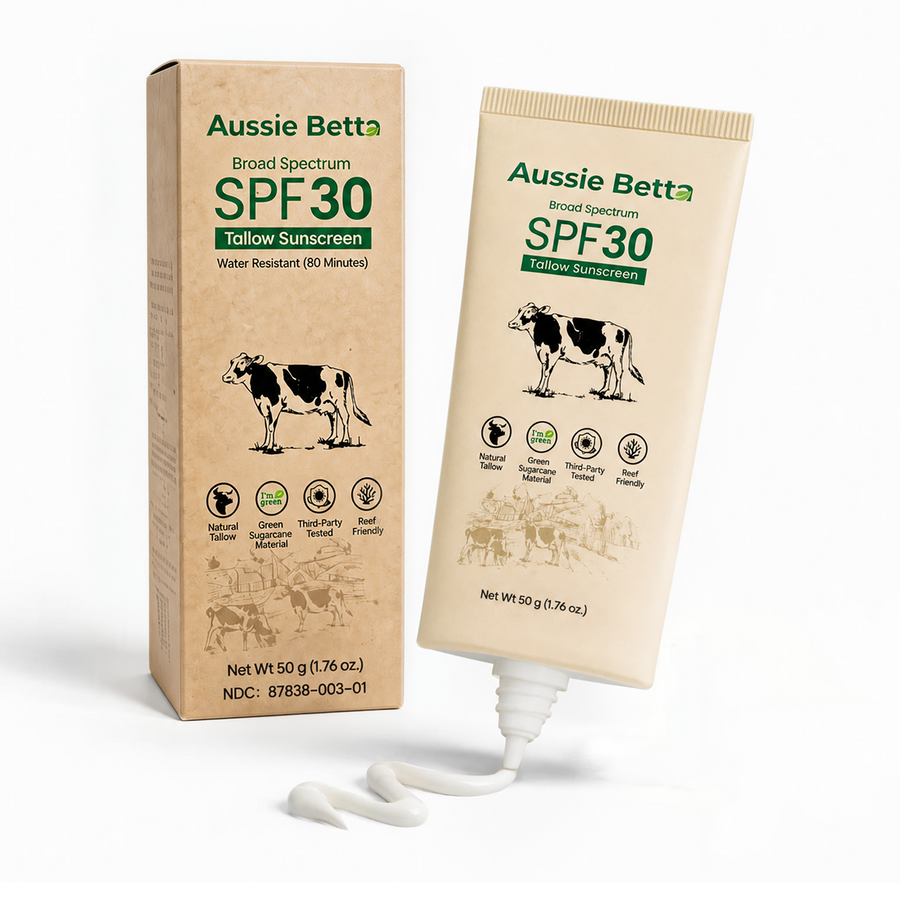
SPF30 Mineral
A mineral UV-filter system created around everyday facial wear.
- Face-focused daily routines
- Mineral UV filters
- Commuting, work and errands
- Water Resistant (80 Minutes)
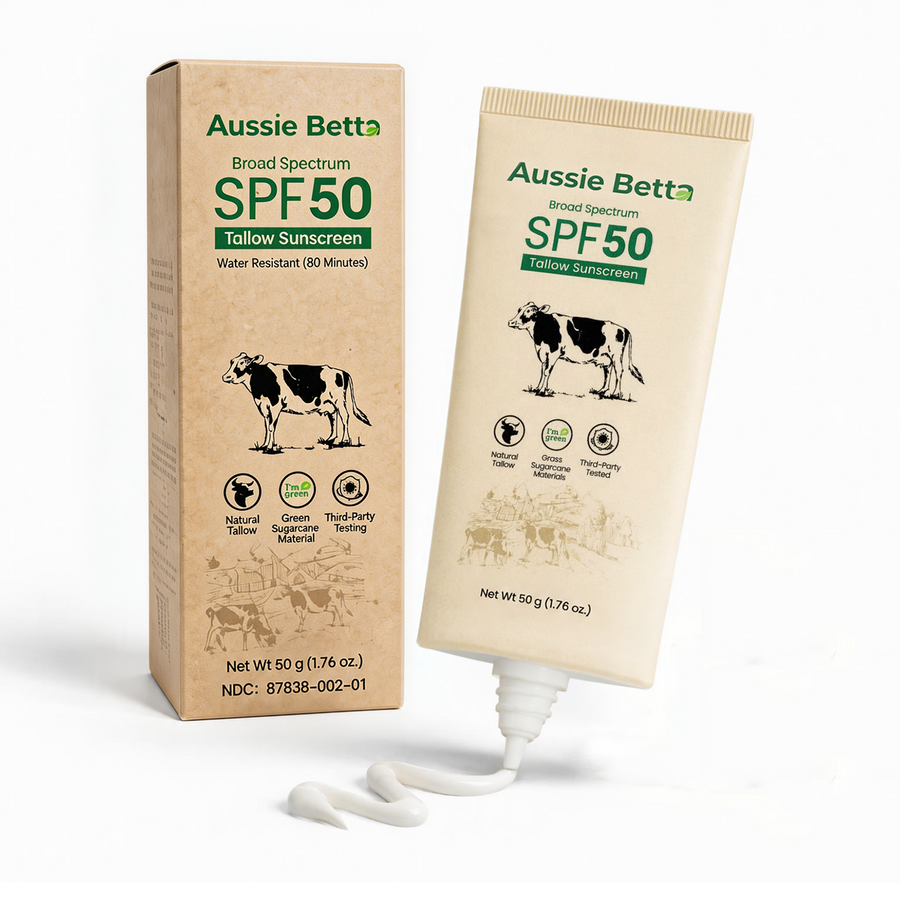
SPF50 Hybrid
A higher-SPF hybrid formula for face-and-body coverage and longer outdoor days.
- Face and body application
- Hybrid UV-filter system
- Beach, sport, hiking and travel
- Water Resistant (80 Minutes)
What exactly went into the studies?
The tests evaluated the finished Aussie Betta SPF30 and SPF50 formulas—not a theoretical blend of their UV filters and not an estimate based on ingredient percentages. This distinction matters because sunscreen performance depends on the entire formula: dispersion, stability, film formation and the way the product behaves once applied to skin.
Both studies followed the same overall human-testing framework so the results could be interpreted with the correct context.

The reports include an approval signature from an Evaluation Dermatologist Technical Supervisor. That represents oversight of the laboratory documentation; it should not be interpreted as a promise that either product will suit every skin type or individual sensitivity.
Why independent testing matters
SPF performance belongs to the finished formula—not to one ingredient in isolation. UV filters must be dispersed correctly, the product must form an even film and the complete formula must perform under a defined test method.
Independent testing introduces a documented procedure and an external laboratory into the claims process. It does not make a sunscreen waterproof, and it never replaces correct application or reapplication. It does give customers evidence that can be examined in context.

How to read an SPF result responsibly
An SPF result is not a simple percentage taken from an ingredient list. It is a measured comparison between protected and untreated skin under a defined protocol. The result is influenced by the finished product, the applied amount, the ultraviolet exposure method and the study population.
That is also why the condition attached to a number matters. A dry-skin result and a post-immersion result answer different questions. In this article, the reported Aussie Betta values are discussed together with the 80-minute immersion protocol so the numbers are not separated from the way they were obtained.
Who tested the formulas?
Both finished formulas were evaluated by Intertek Testing Services Shenzhen Ltd. Guangzhou Branch. Intertek provides testing, inspection and assurance services, including sunscreen SPF and water-resistance evaluation.
Each Aussie Betta study included 10 human participants—eight women and two men, aged 19 to 56—with controlled application, calibrated ultraviolet exposure and an 80-minute water-immersion protocol. The reports also include technical review and an Evaluation Dermatologist Technical Supervisor approval signature.
How the human SPF test works
- Establish the baselineUntreated test areas receive controlled ultraviolet doses to establish an individual skin-response baseline.
- Apply a measured amountThe finished sunscreen is applied at 2.00 ± 0.05 mg/cm²—the controlled density used for the study.
- Complete the water protocolFour 20-minute periods of water activity are separated by controlled rest and air-drying periods.
- Compare the responseProtected skin is compared with the untreated baseline to determine the measured SPF under the study conditions.

For the water-resistance portion, participants completed four 20-minute periods of water activity. Controlled rest and air-drying periods were used between the water blocks, and the skin was allowed to dry without towelling before evaluation continued.
This procedure is designed to create a consistent laboratory condition. It does not reproduce every beach, workout or swimming situation. Salt water, chlorine, movement, rubbing, sweat, clothing and towel drying can all disturb a sunscreen film differently in real life.
An 80-minute result means the SPF was evaluated after a standardized water-immersion protocol. Reapply after 80 minutes of swimming or sweating, immediately after towel drying and at least every two hours.
The results, without the spin
Laboratory studies produce a range of participant responses. The average, confidence interval and reported post-immersion value together provide more context than one headline number alone.
SPF30 test result
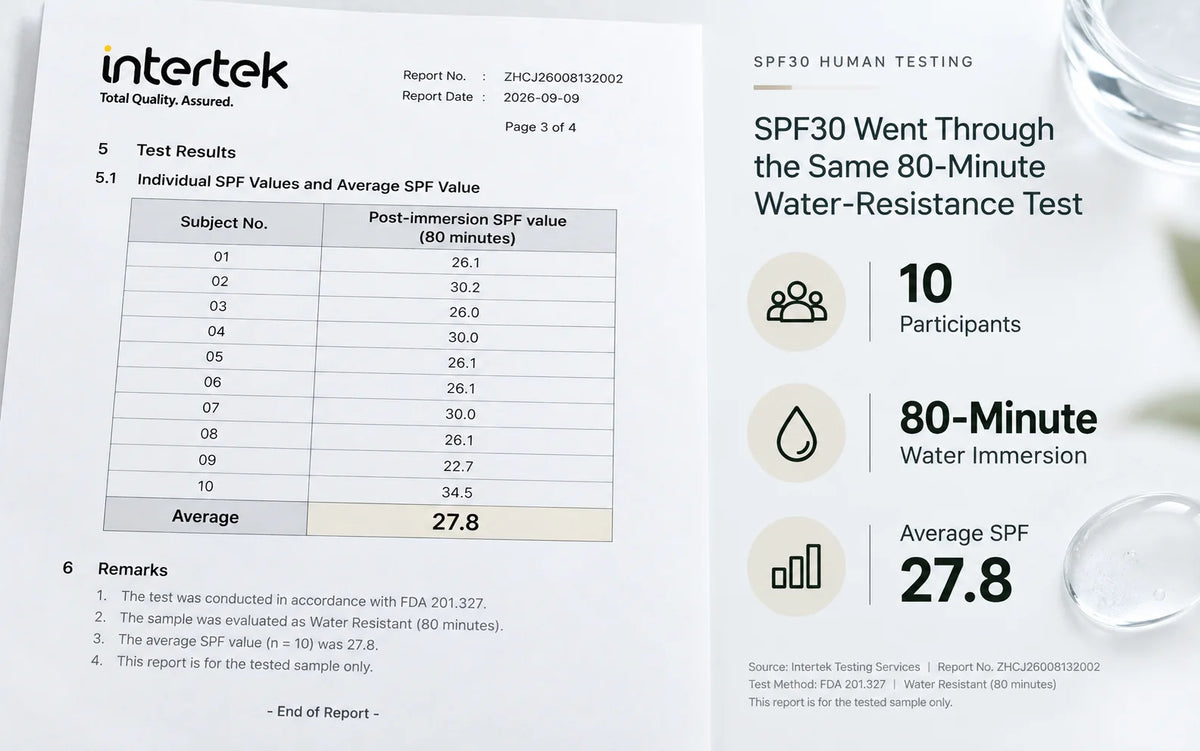
- 95% confidence interval
- 25.4–30.2
- Reported post-immersion value
- 27
- Participants
- 10
SPF50 test result

- 95% confidence interval
- 49.5–62.1
- Reported water-resistant value
- 55
- Participants
- 10
How the two results compare
The two formulas were tested using the same application density and the same duration of water immersion, but they serve different roles in the Aussie Betta range. The comparison below is intended to make those differences easier to scan—not to declare one formula universally better.
What the results do—and do not—tell us
The results do tell us
- The finished formulas were tested rather than estimated from their ingredients.
- Human participants were involved in the SPF evaluation.
- A controlled application density and UV exposure procedure were used.
- The reported values followed an 80-minute water-immersion protocol.
- The two formulas produced different measured results under the study conditions.
The results do not tell us
- That either sunscreen is waterproof.
- That every person will obtain exactly the laboratory result.
- That a thin or uneven layer performs like the tested amount.
- That reapplication can be skipped.
- That sunscreen replaces shade, clothing, hats and sunglasses.
These results describe performance under the defined study conditions. They do not promise that every person will experience an identical result, or that a thin, uneven layer will perform like the tested application amount.
What the laboratory cannot control: real life
People miss the ears, hairline and shoulders. We sweat, swim, towel off, pull clothing across protected skin and sometimes apply less product because we prefer a lighter finish. That is why daily habits matter as much as the number on the tube.
Turning laboratory conditions into a daily habit
Laboratory testing controls variables so a formula can be compared consistently. Everyday life does the opposite: application is rushed, amounts vary and exposed areas are easy to miss. The most useful way to respond to testing evidence is to improve the routine around the product.
Apply before exposureUse the product liberally and evenly 15 minutes before sun exposure so covered areas receive a consistent layer.
Cover the easy-to-miss areasRemember the ears, hairline, sides of the face, neck, shoulders and other exposed areas appropriate for the product.
Reapply on scheduleReapply at least every two hours, after 80 minutes of swimming or sweating, and immediately after towel drying.
Build a complete sun planUse shade, protective clothing, a hat and sunglasses alongside sunscreen whenever possible.
Why choose SPF30 when SPF50 has the higher result?
A higher measured SPF is meaningful, but it is not the only part of a good sunscreen decision. Application area, UV-filter preference, daily routine and willingness to use enough product all matter.
Within the Aussie Betta range, SPF30 is the mineral, face-focused option for everyday wear. SPF50 uses a hybrid UV-filter system and is designed for face-and-body use across daily and longer outdoor routines. Some customers prefer to select by filter system or intended application area rather than automatically choosing the highest number.
Formula feel is personal. The best choice is the product you can apply generously, spread evenly and reapply as directed. Neither SPF number compensates for missed areas or an application that is too thin.
Questions customers ask us most
Was the SPF evaluated on people?
Yes. Each study included 10 human participants under a defined SPF testing procedure.
Why is the laboratory application amount important?
The study used 2.00 ± 0.05 mg/cm². Applying much less product or leaving gaps can reduce practical protection compared with the tested conditions.
Does 80-minute water resistance mean waterproof?
No. Reapply after 80 minutes of swimming or sweating, immediately after towel drying and at least every two hours, following the complete package directions.
Why does the SPF30 report discuss a value of 27?
The report recorded an average measured post-immersion SPF of 27.8 and a reported post-immersion value of 27 after the defined 80-minute protocol. The measurement condition is essential context.
Does independent testing mean I can reapply less often?
No. Testing supports the evaluated claim; it does not change the labeled application and reapplication directions.
Is the SPF50 automatically the better choice for everyone?
No single formula is automatically right for every routine. SPF50 provides the higher labeled SPF result, while SPF30 offers a mineral, face-focused option. Consider application area, outdoor exposure, filter preference and the formula you will use correctly.
Can I compare the laboratory numbers directly with everyday wear?
Use them as controlled evidence about the finished formulas, not as a guarantee of identical real-world performance. Application amount, coverage, water, sweat, rubbing and reapplication all affect practical protection.
Choose the formula that fits your day
Protection only works when you want to wear it.
Go mineral and face-focused for the everyday routine, or choose higher-SPF face-and-body coverage for longer outdoor days.
Editorial and compliance note: This article explains the testing documentation supplied for the two Aussie Betta sunscreen formulas and general sunscreen-testing concepts. It does not replace the complete Drug Facts, warnings or directions on the package. For external use only. Avoid contact with eyes. Do not use on damaged or broken skin. Stop use and ask a doctor if a rash occurs. Ask a doctor before use on children under six months of age.
Sources: Intertek Sunscreen Testing Expertise; FDA Labeling and Effectiveness Testing Guidance.